Author: admin

  • Family Reunification Day 2023

    Family Reunification Day 2023

    Celebrating Positive Outcomes – Family Reunification!

    June is recognized by The American Bar Association as National Family Reunification Month. In Maricopa County, we gathered together on June 24, 2023 with a purpose:

    To CELEBRATE the accomplishments of families who have overcome an array of challenges to reunify safely and successfully.

    To RECOGNIZE the vital role that community partners- including mental health and substance abuse providers, courts and judges, foster parents, social workers and others – play in helping to reunify, strengthen, and support families.

    To INSPIRE other parents – particularly those going through the recovery process – that it is possible to confront and resolve challenges that led to their family’s separation, and to reunify with their children.

    VOICES knows CASA volunteers are an important factor in this journey and therefore have been a key sponsor of FRD since 2014. Dignitaries and community leaders, including Governor Hobbs and The Honorable Lori Bustamante, Presiding Judge of the Maricopa County Juvenile Court, gathered to highlight the positive impact of reunified families on the community. DCS Director Lujan also delivered a video message of support and encouragement.

    A new ‘Family Reunification Network’ was also launched on Foster Cooperative where families can register and engage in peer and community support.

    Other sponsors include Casey Family Program, Family Involvement Center, and the Governor’s Office of Youth Faith and Family (to learn more and see information on past events)

    Each year, partners across Maricopa County come together to rally for families who have reunified with their loved ones. Thousands of Arizona children are reunified with their families every year and the outpouring of love and joy our families have for each other inspires the entire community.

  • A CASA’s Guide to Virtual Volunteering in Phoenix

    A CASA’s Guide to Virtual Volunteering in Phoenix

    CASA of Maricopa County volunteers share their tips and tricks for continuing to connect with foster children and make a difference, even while quarantined at home.

    The global pandemic has made a lot of things more challenging — school, work, human connection, community volunteerism. Keeping our distance is important for the health of our communities and slowing the spread of COVID-19, of course, but that physical distance can sometimes make it more difficult to connect with foster children and make a difference.

    But the good news is that over the past several months, we’ve been learning and adapting — and discovering ways to connect with children, even while quarantined at home through virtual volunteering. Here are eight tips to try as a CASA of Maricopa County volunteer when you can’t do in-person case visits.

    Get creative with conversation. The screen can often be a barrier for children when having a conversation. And especially if they’ve been stuck at a computer all day for virtual learning, hopping on a Zoom with yet another adult might not be their top priority. Still, it’s important to build that connection and be able to listen. If conversation is a struggle, get creative and invite the child to share in other ways. Ask them to show you something they did in school or sing a song. Play games like Simon Says or virtual charades.

    “COVID has definitely changed things.  We can finally see our kids in person again now but we still can’t take them anywhere,” says Stephanie Webster, who has been a CASA for nearly 6 years. “Due to the distance my child lives from me, I have been FaceTiming and having Zoom calls. We talk a lot and I read to her on an ongoing basis a few chapters at a time from an old book of mine that I thought she would enjoy.”

    Eat “together.” You can’t take kiddos out for ice cream or lunch. But you can still eat together. Set up a Skype or Zoom call for a weekend lunchtime and arrange for food delivery. Then, you can eat together virtually and talk.

    Write letters. If the child you’re advocating for is reading age, you can start a pen-pal campaign—either via physical written (yes, in the actual mail) letters or email. It’s a way for them to communicate their feelings (and it may even be easier for them than talking on the phone).

    “I gave the child I work with a set of the Little House series and asked her to read a chapter or two and write me a report,” Webster says. “I sent her self-addressed envelopes with paper and she’s been good at returning and reporting. I then corrected her errors and returned her work, sometimes with a few dollars for incentive. This child has always been behind in reading and writing and spelling, so this was good practice.”

    Set up a scavenger hunt. Engage kids with a scavenger hunt via Zoom that helps you check in and lets them play.

    Play an online game. Find something the child is interested in—whether it’s chess, word games or video games—and try to connect via an online game.

    Build a vision board. Provide the child with pictures from magazines and schedule a video call to help put a vision board together. Invite the child to share their feelings or hopes for the future.

    Read a story together. Find a book or series the child can engage with, and depending on the child’s age, read it with—or to—them. For older children, you can take a “book club” approach and each read a few chapters independently and come together to discuss. No matter the child’s age, reading can be a great activity to encourage engagement. Plus, for some children, it’s an opportunity to explore emotions or safely escape the reality of the moment.

    “I currently have a 2- and 3-year-old so it has been challenging to connect electronically.  They have very short attention spans so I had to get creative to keep it interesting for them,” says Patty Turrentine, who has been a CASA for more than three years. “We have Skyped and read stories over the phone, and I talk weekly with foster parents and caseworkers to stay informed and be able to advocate for what they need.”

    Care packages. Send a little something to show you care with a gift that helps the child through this time in their life. Consider something simple like a journal or a special book.

    “In some ways, I feel I have worked my case more with the COVID restrictions because I have time to dig into the legal aspects a little more,” says Turrentine. “I have been able to find resources for things the girls need like beds, clothing and diapers.”

    And if you’re feeling unsure of how to connect while staying safe, consider utilizing the resources from Voices for CASA.

    “Voices for CASA Children is so supportive of CASA volunteers and there are so many training opportunities and community events, even virtually,” Webster says. “Adaptability is the name of the game.”

    Get Started Today!

    Fill out the online Volunteer Certification Application to get started on your path to transforming a child’s life.


  • Combating Childhood Trauma

    Combating Childhood Trauma

    A childhood marked by abuse, neglect and other trauma can have long-ranging impacts, affecting a person well into adulthood. But the work you’ll do as a Court Appointed Special Advocate (CASA) can change a child’s life and even stunt the impact of the trauma they’ve endured.

    Adverse childhood experiences, or ACEs, are traumatic events that can cause excess stress for a child. ACEs can include abuse, neglect and growing up in a family with mental health or substance use problems. The stress caused by ACEs can have both physical and mental health repercussions, such as changes in brain development. That’s because the overload of stress hormones harm the brain, and that can affect how a child learns and copes with stress and even their decision-making processes.

    These impacts of adverse childhood events aren’t something a person just outgrows. ACEs are linked to chronic health problems like depression, asthma, cancer and diabetes in adulthood — as well as a greater risk of risky adult behaviors like smoking, heavy drinking and drug use. Plus, childhood trauma also is associated with lower education and employment potential.

    For children who’ve experienced neglect and abuse or other trauma, the impact of these adverse childhood events isn’t a forgone conclusion. CASA volunteers help ensure children get the services they need to help them heal and develop resilience.

    But beyond making those connections, research shows that positive, stable relationships with adults, such as a CASA, can change the trajectory of a child’s life. That’s why judges are more likely to assign a CASA volunteer to children with more serious, complex situations.

    Research indicates that supportive relationships are critical to resilience — and that with the appropriate support, the damage of childhood trauma can in fact be reversed. And that’s especially important, researchers say, because children who don’t resolve their traumas are likely to become adults who can actually perpetuate an ACEs cycle, passing ACEs on to their own kids. That can manifest as abuse, neglect or a dysfunctional environment at home.

    One study from 2015 examined kids who had been removed from their homes and placed in stable, high-quality foster care homes versus in institutionalized care. Based on MRIs conducted six years apart, the children who’d been placed in a nurturing setting had different brain structures than the children in institutionalized care. Safe, stable, nurturing relationships can actually change a child’s brain.

    As a CASA of Maricopa County volunteer, you can be one of the nurturing relationships in a child’s life — and make sure they are placed with a loving family who can ensure they continue to have the safety and stability they need to thrive.

    Get Started Today!

    Fill out the online Volunteer Certification Application to get started on your path to transforming a child’s life.

  • Looking to Help in Arizona’s Foster Care System? How to Choose the Right Organization to Volunteer For

    Looking to Help in Arizona’s Foster Care System? How to Choose the Right Organization to Volunteer For

    This is not easy work, but it may be some of the most important work you’ll do. Learn what it takes to be a CASA of Maricopa County volunteer.

    Ask yourself the following questions to decide whether becoming a Court Appointed Special Advocate (CASA) volunteer is the right path for you, as well as how to choose an organization to volunteer for.

    Start with the following questions:

    Do I have a desire to make a difference in my community?

    Children’s safety and well-being is essential to the health of a community. As a CASA volunteer, you’ll make your community stronger by helping to ensure a child is safe and cared for. CASA volunteers even help make sure a child stays in school and out of jail. Plus, helping to reverse the impact of childhood trauma can have long-range benefits that we may not even be able to fully comprehend.

    Am I a good listener?

    CASA volunteers listen to a child as well others in that child’s life such as relatives, parents, foster parents, teachers and more. The information you’ll gather through listening will help you make informed recommendations about what is best for the child.

    Do I have passion for helping children and the ability to nurture or mentor?

    Research tells us that the damage of childhood trauma can be reversed, and having a positive supportive relationship with an adult is a major factor in that healing work. CASA volunteers are advocates in court, yes, but they are also mentors and nurturing influences in a child’s life.

    As a CASA of Maricopa County volunteer, you can have a tremendous impact in your local community. For one, you can increase a child’s likelihood of finding a safe permanent home and being adopted. You’ll be able to make sure they get the resources and services they need to thrive academically, mentally and socially. Plus, you’ll be a consistent adult presence, which is invaluable.

    How much time can I commit?

    Once your initial training is complete, working a case requires an average of about 15 to 20 hours per month. It can take up to a year and a half for a case to be resolved. Because of what these children have been through, continuity and trust are paramount. So, once you commit to a case, you are asked to stay until the case is resolved, which typically takes about a year and a half.

    Do I have the appropriate professional background?

    CASA of Maricopa County volunteers have a wide variety of backgrounds and careers. No prior legal training or other education is required. In fact, we want people of all professions — as well as all cultures, ethnicities and educational backgrounds — to apply to become CASA volunteers.

    What kind of support do I need?

    As you explore organizations to volunteer for, you’ll want to make sure you have the resources you need to succeed. CASA volunteers receive upfront training of about 30 hours, plus additional continuing education opportunities from the national and state CASA associations. Plus, CASA of Maricopa County has a continued support system in place to make sure you are supported and always feel confident you’re able to handle every situation in the best way possible.

    Get Started Today!

    Fill out the online Volunteer Certification Application to get started on your path to transforming a child’s life.

  • 5 Reasons to Become a Foster Care Volunteer

    5 Reasons to Become a Foster Care Volunteer

    The impact that a Court Appointed Special Advocate volunteer makes can be life changing. Learn why this role is so important.

    In 2020, nearly 825 Arizona children each month have been removed from their homes due to neglect or abuse and placed into foster care. In addition to families who’ve volunteered to care for these children in their homes, there are other important foster care volunteers, known as CASAs. Court Appointed Special Advocates (CASAs) are foster care volunteers doing an important job — speaking up for these children in court.

    CASA volunteers don’t need to have a law degree or a career in legal services. In reality, CASA volunteers are just regular adults who care. Here are five reasons why these volunteers are so vital.

    There’s a significant need. Only 1 out of every 5 children in foster care in Maricopa County has a CASA volunteer fighting for them. Statewide, there are more than 12,000 children waiting for a volunteer to help them find a safe and loving home. So, every person who steps up to volunteer can make a difference.

    You can change — even save — a life. As a CASA of Maricopa County volunteer, you’ll make sure that a child has the services they need to thrive. That means making sure they’re safe and have the healthcare they need as well as academic and social services. Your work can be the difference between a child finding a loving family and becoming homeless or the difference between completing school and dropping out. A child who has a CASA volunteer fighting for them is more likely to find a safe, permanent home or be adopted, half as likely to re-enter foster care and typically spends less time in foster care. They’re also more likely to succeed in school. Plus, you’ll develop an important trusted bond: You will be that child’s advocate until his or her case is closed or they’re permanently placed with a family.

    It’s a manageable time commitment. Once your training is complete, you’ll have about a 15- to 20-hour (average) monthly commitment. Talk about an incredible return on just 3-4 hours a week!

    You’ll have the support you need. In addition to the initial 30-hour training, CASA of Maricopa County volunteers have lots of opportunities to continue their education and ongoing access to resources to help them. You’ll have ample support so you can be confident as an advocate for a child.

    Your community will thank you. Our communities are stronger and healthier when children are safe and cared for. CASA volunteers can sometimes be responsible for ensuring a child stays in school — and even out of jail. This isn’t easy work, but it’s important work that benefits children and communities.

    Get Started Today!

    Fill out the online Volunteer Certification Application to get started on your path to transforming a child’s life.

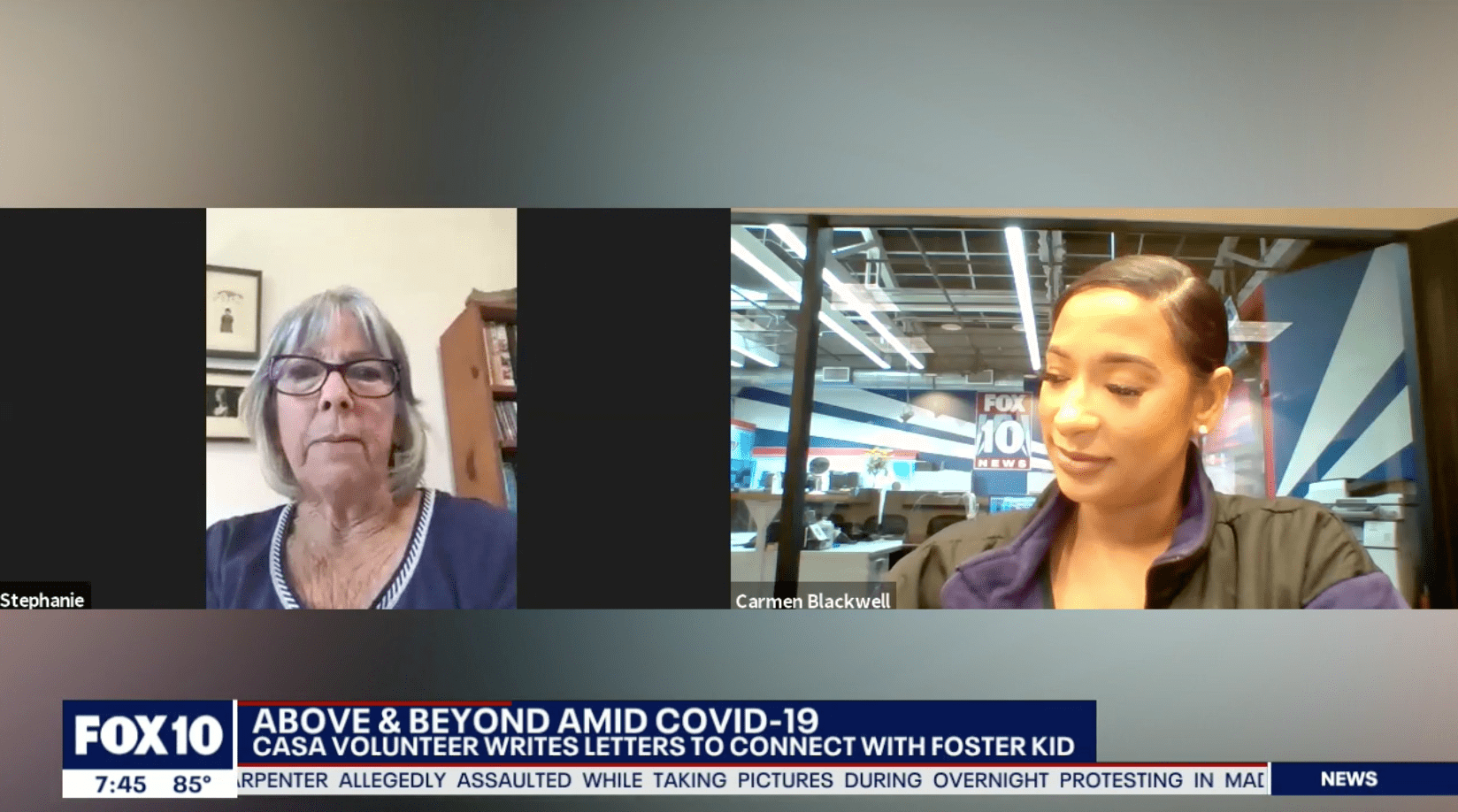
  • CASA Volunteer Goes Above and Beyond with Connecting with her CASA Kid

    CASA Volunteer Goes Above and Beyond with Connecting with her CASA Kid

    As social distancing has caused CASA volunteers to be creative with how they connect with their CASA youth, one volunteer has gone beyond virtual meetings to connect with her 12-year-old.

    CASA volunteer, Stephanie Webster, has been encouraging her CASA youth to work on her reading and writing skills during this time. She originally sent her 12-year-old four addressed and stamped envelopes, encouraging her to read a chapter of her book and send Stephanie a written synopsis.

    To learn more, watch the full FOX10 segment here.
  • Volunteers Needed to Help Advocate for Foster Youth

    Volunteers Needed to Help Advocate for Foster Youth

    As one of the most vulnerable populations, foster youth need stability and someone to advocate on their behalf. 

    The warm summer months offer an opportunity for interested individuals to learn more about the role of a CASA volunteer and what it takes to be an advocate for foster youth in the system. To understand more about the CASA volunteer role, individuals can attend an informational session to discover the positive, life-long impact a volunteer can have in a child’s life.

    To learn more, read the full Arizona Health & Living piece here.
  • “My Why” ~ CASA Roger Lurie Shares His CASA Journey

    “My Why” ~ CASA Roger Lurie Shares His CASA Journey

    Let me start by telling you a bit about myself. I am a 65-year-old man with a wife, two grown children and two young grandchildren. I am passionate about spending time with my family, traveling and recreational sports including running, hiking, and swimming.

    My career has been spent at Arizona State University, providing management oversight over technical solutions to enhance student experience and support administrative functions. However, the aspect of my job that brings me the most satisfaction has been mentoring and coaching student interns. Seeing bright and energetic minds grow professionally as they pursue a college degree and supporting their career development is rewarding.

    My father passed away suddenly from an illness when I was ten years old. He left behind my mother, four boys with ages ranging from five to twelve, and a business in crisis that left the family with financial challenges. My Mom re-married a couple of years later and my step-father had a strong influence on me in my childhood. He brought with him such a strong sense of patience and love – after all, he was a single man suddenly immersed into a house of adolescent boys. This had a profound and lasting impact on my life. As a child, I loved my summers when I would go away to summer camp; for many years in northern Wisconsin and then later in the mountains of Colorado. I grew to love the western United States and adventures backpacking in Rocky Mountain National Park. This triggered a strong passion for recreation, adventure, travel, and the outdoors that has stuck with me to this day.

    After more than 30 years of professional experience and impending plans to step back into semi-retirement, I sought a meaningful volunteer opportunity supporting youth. With no legal background or experience working with foster children, I was compelled to check out the role of being a Court Appointed
    Special Advocate (CASA). As a CASA, I found I would have the opportunity to get to know, be-friend, and advocate on behalf of children that have suffered abuse or neglect in a home situation. As I spoke to friends who were familiar with the role of a CASA, and after a conversation with my mother in which I learned that my step-father had served as a CASA, this opportunity got my attention and interest.

    Serving as a CASA has been tremendously rewarding to me personally and professionally. I consider myself to be very fortunate to have good health, a stable family background and an income source that has enabled me to provide for myself and my family. I have now served as a CASA for three years and am
    currently on my fourth case. My first three resulted in satisfactory reunification with biological parents. I have
    experienced children that have had significant trauma during their youth, but such strong potential and bright minds. I have seen children that have a strong bond and love for their parents, regardless of the uncertainty and difficult situations that they have been exposed to. If we don’t support and advocate for
    these youth, I fear what will happen to them when they reach adulthood.

    I have so much hope for these kiddos. They deserve a quality experience in their youth and opportunity to excel in school, participate in extracurricular activities and know with confidence that they have someone looking out for them that cares. A dedicated CASA can break through barriers and be
    supportive of these youth in ways that the busy professionals on the cases are unable to do so.

    In closing, I want to share a couple of stories that have been impactful to me during my time as a CASA. A young man I had advocated for was suddenly removed from a foster home after an altercation. He landed in a temporary shelter and I went to visit him the same day. When he saw me, he ran to the door and
    hugged me and said, “I was so scared that I would never see you again.” Another incident is the high school student I advocate for who joined me for parent teacher conferences recently. This kiddo remarked to me, “no one has ever cared enough to attend parent teacher conferences with me.” These are the stories that
    convince me that as a CASA, I can make a substantial difference in a child’s life and keep me engaged as a CASA for many years to come.

Thank you for your interest in becoming a CASA.

After completing this form you will be directed to the CASA volunteer application which is located on the CASA of Maricopa County website. If you have any questions please contact us at info@voicesforcasachildren.org.

Thank you! You will now be directed to the CASA application. Feel free to call us during business hours - (480) 685-4888.

Learn More header

Thank you for your interest in becoming a CASA.

After completing this form you will be directed to the CASA volunteer application which is located on the CASA of Maricopa County website. If you have any questions please contact us at info@voicesforcasachildren.org.

Thank you! You will now be directed to the CASA application. Feel free to call us during business hours - (480) 685-4888.